

 By amber@cossni.com
How to Choose a Leather Wallet Manufacturer: A 10-Point Supplier Checklist
- Define Your Product and Order Specs First
- Verify Production Capability and Capacity
- Check Materials and Craftsmanship Standards
- Looking for a Reliable Leather Wallet Manufacturer?
- Quality Control: What a Serious Factory Does
- Certifications and Compliance
- Sampling, Communication and Lead Time
- The 10-Point Supplier Checklist
- Final Thoughts
- FAQ
Every sourcing manager knows the real cost of picking the wrong leather wallet manufacturer. A delayed shipment misses the selling season. A bulk batch arrives with stitching that unravels after two months on shelves. Or the “factory” turns out to be a trading office reselling another workshop’s work. Add rework costs, chargebacks from unhappy retail partners, and the weeks lost re-sourcing mid-season. A weak supplier decision becomes one of the most expensive mistakes in the accessories business.
This guide gives you a ten-point supplier checklist written from the factory side of the table. We manufacture leather wallets in Guangzhou. Every point below is a question a serious leather wallet manufacturer should answer without hesitation.
Define Your Product and Order Specs First
Most stalled sourcing negotiations trace back to one cause: the buyer has not written down what they are actually trying to buy.
Style, Materials and Hardware Requirements
A useful spec sheet names the silhouette: bifold, trifold, long zip-around, card sleeve. Add the closure type, card slot count, closed dimensions in millimeters, thread color, edge finish, leather grade, lining material and hardware finish. Reference photos of two or three wallets, one you love and one you dislike, communicate more than a page of adjectives ever will. When the spec is vague, the factory fills the gaps with its cheapest interpretation. Those quiet defaults later show up as a cost overrun or a quality complaint. Decide these points in writing before you send the first email. If you are unsure how to specify materials, our materials and craftsmanship page explains the grades and finishes factories actually work with.
Target MOQ and Price Range
State your target order quantity and unit price openly, even if the numbers are still approximate. A factory that only runs 5,000-piece lines will waste your time if you need 300 pieces. A small workshop will collapse if you suddenly need 20,000. Sharing both numbers also lets a supplier tell you honestly whether the project fits before either side invests design hours. For reference, custom wallet projects at our factory start at a 100-piece MOQ, with sampling of 7–10 days. Use those benchmarks to calibrate any quote that lands far away from these figures, in either direction. A supplier whose MOQ and pricing sit far outside your stated range should explain why. The explanation usually reveals whether the mismatch is real or invented.

Verify Production Capability and Capacity
A supplier’s brochure can claim anything, but a production floor can only hide so much. So verify the numbers behind the marketing.
Factory Lines and Monthly Output
Ask directly: how many production lines, how many workers, and what is the monthly output? A serious manufacturer answers instantly; a trading office deflects to “our partner factory.” Ask for a video tour and, if possible, the line’s current utilization. A factory running at 100% capacity is not a good sign for your delivery date. As a benchmark, our Guangzhou facility runs four production lines with 200+ skilled workers across 10,000 m². Its monthly capacity is roughly 100,000 pieces. Whatever the numbers, they should be stated in the first conversation, not buried in a capability deck. If an on-site visit is not possible before ordering, ask for a dated video walk-through of the cutting, stitching and finishing areas. Match what you see against the claimed headcount. An empty floor does not produce 100,000 pieces a month.
Matching Capacity to Your Order Size
Capacity cuts both ways. You want a factory big enough to meet reorders without derailing other clients. It should also be small enough that your project is not invisible in the queue. Three questions reveal the fit. Where would my order rank in your current production schedule? What are your smallest and largest in-production orders right now? And how do you handle two clients’ peaks colliding in the same month? A factory that answers with a plan instead of a promise is the one to trust. It will actually hold your slot when the season turns.

Check Materials and Craftsmanship Standards
Leather grades are where factories cut corners first, because the savings hide under a smooth finish and a good photograph.
Leather Grades and Material Sourcing
Ask the supplier to name the grades they use (full-grain, top-grain, genuine/split) and where the hides come from. A factory that cannot tell the difference between full-grain and split leather, or that will not disclose its tanneries, cannot control your quality. Request a physical material swatch card before quoting. Photos flatten texture and hide finish weight; a swatch is the one thing you can compare across suppliers. We work with full-grain and top-grain leathers, Couro reciclado com certificação GRS, and PU and microfiber alternatives. We also document the origin of each material batch, the same documentation your retail partners may audit later.
Costura, Edge Finish and Hardware Quality
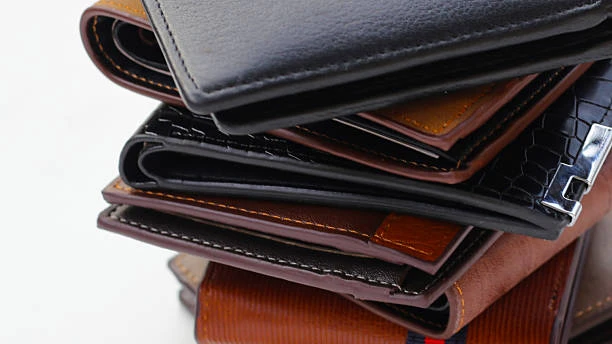
Request close-up photos or physical samples of stitching density, edge paint and hardware attachment. Three details separate a wallet that looks premium for three years from one that looks tired in three months. Stitch count per inch: more stitches read finer and hold longer. Edge finish: painted or burnished evenly, with no cracks at the fold points. Hardware: it sits flush and survives a firm pull. The wallets in our catalog show the standard we hold. We are happy to send pre-production samples so you can judge workmanship before committing a cent to bulk production. Ask about the factory’s edge-finishing method too. Painted, burnished or turned edges each wear differently. The method should match the retail price, not the factory’s convenience.
Looking for a Reliable Leather Wallet Manufacturer?
Quality Control: What a Serious Factory Does
Quality is not inspected into a wallet at the end of the line; it is built in at each workstation along the way.
In-Line and Final Inspection
Ask how many inspection points a wallet passes. A capable factory checks components at cutting, for panel flaws and wrong thickness. After stitching, it checks tension and skipped stitches. At final assembly, it checks alignment and hardware function. It does not check only once at the end, when the box is already sealed. Our QC process includes in-line checks at each of these stages plus a 100% final inspection on finished wallets. If a supplier’s answer is “we check everything before packing,” ask again more specifically. The detail of the answer is the audit.
QC Lab and Defect Rate Targets
A dedicated QC lab and a stated defect-rate target are strong signals. A lab lets the factory test color fastness, stitch tension, zipper cycles and edge paint adhesion instead of eyeballing them. A stated target, measured against agreed AQL standards, tells you the factory manages defects as data rather than anecdotes. We operate an in-house QC lab and hold bulk orders to agreed AQL standards. We also record defect data per batch so you can track consistency across reorders. If a factory cannot tell you its defect-rate target, treat that as a warning sign. Ask to see a sample batch report from a recent order. Even a redacted one shows how the factory thinks about quality.
Certifications and Compliance
Three letters on a certificate mean nothing unless you know what each one actually covers.
BSCI, ISO 9001 and GRS Explained
BSCI covers social compliance: working conditions, working hours and labor practices inside the factory. ISO 9001 covers the quality management system: documented processes, corrective actions and continuous improvement. GRS certifies recycled material content and its chain of custody, so eco claims are verifiable rather than decorative. For buyers importing into the EU, supplying retail chains, or marketing a sustainable line, these are often contract requirements rather than nice-to-haves. We hold BSCI, ISO 9001 and GRS certifications and provide the documents during sourcing, before you have to ask twice.
Export and Materials Compliance Documents
Ask for the export documents you will actually need in your market: commercial invoice and packing list handling, materials declarations, and test reports. That includes REACH-related material testing for the EU or documentation for California retail. A manufacturer experienced with your region volunteers this list unprompted; a less experienced one learns it on your shipment, at your cost. Compliance gaps discovered at customs are among the most avoidable delays in the whole supply chain. They are entirely preventable with one early question. A practiced exporter can also advise on the labeling and packing marks your market requires. This small detail decides whether a shipment clears in days or in weeks.
Sampling, Communication and Lead Time
A factory’s true working speed shows up in its sampling calendar, not in its sales pitch.
Sampling Speed and Revision Process
A manufacturer that samples slowly is one you cannot iterate with. Ask for a concrete sampling timeline and how revisions are handled. Specifically, ask who owns each revision round and how many days it takes. At our factory, design drafts take 1–3 days and a custom sample ships in 7–10 days. Revision rounds are structured, so each round has a defined turnaround instead of an open-ended promise. Treat a vague “soon” as a red flag. Sampling speed predicts how the entire project will communicate once money is on the table. Ask for the same turnarounds in writing, and note whether the factory volunteers a contact person and a feedback channel. Responsiveness during sampling is the best available preview of responsiveness during production.
Production Lead Times and After-Sales Support
Confirm bulk lead time in writing. For us, that is 30–45 days after pre-production sample approval. Then ask what happens after delivery. Who handles a defective batch? How quickly are issues resolved? Does the factory keep your patterns and materials on file for reorders? After-sales is where supplier relationships quietly live or die. Every wallet program eventually has a reorder, a quality question or a packaging change. A factory that stores your patterns, logo tooling and color formulas makes your second order faster and cheaper than your first.
The 10-Point Supplier Checklist
The six sections above come down to ten checks. Work through them in order before you sign anything.
- Spec sheet written. Style, materiais, hardware and dimensions on paper.
- Quantity and price stated. Target MOQ and unit price range declared upfront.
- Capability verified. Lines, workers and monthly output confirmed.
- Order-size fit checked. Your project’s place in the production queue.
- Materials disclosed. Leather grades and sourcing documented.
- Craftsmanship sampled. Costura, edges and hardware reviewed in hand.
- QC process confirmed. In-line and final inspection gates defined.
- QC data stated. QC lab and defect-rate targets on record.
- Certifications documented. BSCI, ISO 9001 and GRS certificates supplied.
- Timelines agreed. Sampling speed and bulk lead time in writing.
Final Thoughts
The ten checks in this guide force evidence instead of promises. Work through them in order before you sign anything. Hold every candidate leather wallet manufacturer to the same standard.
Shortcut the list and the savings disappear in a bad batch. Walk it properly and you will know which factory deserves your order. Cossni has manufactured leather wallets since 1997. We are glad to be measured against every point above. Visit our factory page or contact us to start with your spec sheet.
FAQ
What should I look for in a leather wallet manufacturer?
Look for verified production capability: lines, workers and monthly output. Check disclosed material grades, a structured QC process with defect-rate targets, certifications such as BSCI, ISO 9001 and GRS, and fast, clearly defined sampling. A factory that can state all of these plainly is rare, and usually the right one.
What is a reasonable MOQ for leather wallets?
For custom leather wallets, an MOQ around 100 pieces is common among export factories; some accept lower quantities on stock styles. Be wary of factories demanding far higher MOQs without explanation, and of workshops promising far lower ones without the capacity to back them up.
How long do custom wallets take to produce?
A realistic timeline: 1–3 days for design drafts, 7–10 days for a pre-production sample, then 30–45 days for bulk production after sample approval. Shipping time is additional. Plan accordingly, and get the timeline in writing.
Do manufacturers provide samples before bulk orders?
Sim. Any serious manufacturer provides a pre-production sample so you can approve the workmanship before bulk production. Sample fees are commonly charged. Reputable factories refund them against the bulk order once it reaches the agreed volume, as we do at Cossni.


