

 By amber@cossni.com
Best Leather for Wallet Manufacturing: Grades and Specs for Your Product Line
The best leather for wallet manufacturing depends on your target price, customer expectations, and product positioning. Full-grain, top-grain, and corrected-grain leather each offer different levels of durability, appearance, and cost. Synthetic alternatives serve other market segments. For product developers and wallet brands, these differences directly affect material budgets and retail pricing. They also shape long-term product performance.
This guide compares leather grades, material specifications, and alternative options. It helps you define clear requirements before production. You will learn what to include in a leather spec sheet and how to assess material quality. You will also learn how to communicate requirements to manufacturers. That reduces the risk of unnecessary material costs, and of products that fall short of customer expectations.
The Leather Grades Your Product Line Can Use
Leather grading is a hierarchy of surfaces and strength. Each rung has a price. The skill is buying the right rung on purpose.
Full-Grain and Top-Grain: Premium Specs
Full-grain leather keeps the hide’s original surface, pores and natural marks intact. It is the strongest grade and develops a patina over years. It also carries the “full grain leather wallet” claim that justifies premium pricing. Top-grain has the surface lightly corrected and finished. It is smoother and more uniform, and slightly less tough. It is the workhorse of most mid-to-premium wallets. Both are real leather. Between them, the finish and thickness you specify matter more than the label. A thin, sloppily finished full-grain can underperform a well-built top-grain. Tannage adds another layer to the premium story. Vegetable-tanned leather ages and patinas more noticeably. Chrome-tanned leather stays supple and colorfast. Both are legitimate premium paths with different price tags. The spec sheet should say which one you are buying.
Genuine, Bonded and Split Leather: Budget Specs
“Genuine leather” is a technical term, not a praise. It refers to the lower layers of the hide that remain after the top grain is split off. Split leather can be finished to look acceptable but is weaker and less durable. Bonded leather is shredded leather fibers pressed with adhesive, effectively a leather-content board. These grades have a place in promotional and entry-price products. But you should know you are buying them. Your customers’ expectations should match. Nothing erodes trust faster than a customer who learns the difference from a Google search. Bonded leather deserves special caution at the promotional tier. It looks acceptable in a photo and fails quickly in a pocket. It belongs in giveaway items where nobody expects longevity, not in anything sold with a durability claim.
| Grade | Surface | Durability & Story | Typical Use |
|---|---|---|---|
| Full-Grain | Original hide surface, natural marks kept | Strongest; develops patina | Premium and heritage lines |
| Top-Grain | Lightly corrected, uniform finish | Durable; consistent look | Mid to premium lines |
| Genuine / Split | Lower hide layers, finished over | Weaker; budget story | Entry and promotional lines |
| Bonded | Fibers pressed with adhesive | Lowest cost; limited lifespan | Giveaway and ultra-budget items |
PU and Microfiber: Cost-Performance Alternatives
Not every line wants animal leather. Some that do cannot afford it at the price point they are chasing.
PU Leather: When It Fits Your Line
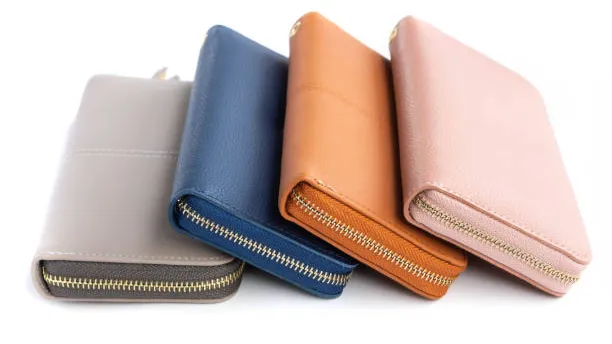
PU leather is a polyurethane-coated fabric, not animal leather. Search queries often call it “PU material in a wallet.” This material is cheap, colorfast, easy to clean and widely used in fast-fashion and promotional wallets. For brands targeting a lower retail price, it offers a practical option. The same applies to collections with seasonal design changes or brands that explicitly avoid animal materials. However, PU leather is unsuitable when your positioning promises “genuine leather.” Such a mismatch can lead to returns, with your own product copy serving as evidence. The material itself is not the problem; the real issue is using it in a product that makes a conflicting claim.
When you do spec PU, two details control the quality:
- The thickness of the PU coating.
- The backing fabric underneath.
Specify both. A thin coating on a weak backing peels within months. That peeling is the failure customers photograph and post.
Microfiber and Recycled Leather Options
Microfiber, often called microfiber PU, is the premium vegan alternative. It feels closer to leather, wears better than standard PU and is frequently specified for higher-end vegan lines. GRS-certified recycled leather is leather fiber recovered from production offcuts, re-bonded and certified through its chain of custody. It lets an eco-positioned brand sell a leather product with a documented recycled story. Both options carry higher material cost than standard PU. They belong where the sustainability or vegan positioning is part of the retail price, not an afterthought. Microfiber’s practical advantage is consistency. It arrives in uniform rolls with repeatable color. That makes it the easy choice for brands that hate batch-to-batch variation in natural leather. Recycled leather inverts that trade. It keeps the leather story but demands the GRS paperwork.

Matching Leather to Wallet Style and Price Point
Material strategy is a matching exercise. The match that matters is between what you build and what the customer believes they are buying.
Which Grades Suit Premium vs Mass-Market Lines
| Tier | 재료 |
|---|---|
| Premium Lines | Full-grain or fine top-grain; vegetable-tanned options for the heritage crowd; hardware in brushed or matte finishes |
| Mid-Market | Top-grain with consistent pebbled or smooth finishes; PU or microfiber for seasonal fashion colors |
| Mass-Market and Promotional | PU, split or bonded, where price per unit beats material story |
The rule is not “expensive material is better.” The material must match the customer’s expectation. A premium grade on a discount shelf is wasted cost. A budget grade at a premium price is a future dispute. Try this exercise when planning a line. Write the retail price first. Work back to the target unit cost. Only then choose the grade. That order keeps the material decision a business decision instead of a preference.
Hardware and Lining Pairings That Hold Margins
Lining and hardware decide whether a mid-grade shell still feels premium. A cheap printed-fabric lining drags a top-grain shell down. A PU shell with velvet or suede lining reads more premium. Customers touch the inside first when they evaluate quality. Zippers and snaps are where wallets fail first. Specify branded or tested hardware, not the cheapest option. These pairings are where buyers protect margin without lying to customers. Upgrade the two details people notice, and save on the material they cannot distinguish. Hardware deserves its own line in the spec. Name the finish, the base material, and whether the zipper should run branded. The pull test a customer performs in a store is the same one a cheap zipper fails.
Spec Sheet Essentials: What to Write Down
The difference between a good order and a disputed one is usually decided before production starts. It sits in the words left unwritten.
Thickness, Finish and Color Standards
Five lines belong on every material spec:
- Thickness, in millimeters.
- Finish: smooth, pebbled, matte or glossy.
- Color reference: a Pantone number or an approved swatch.
- Lining material.
- Hardware finish.
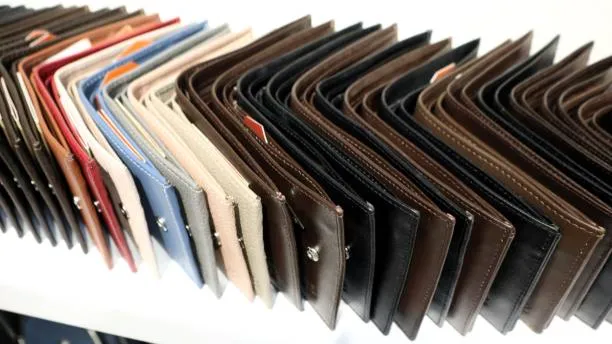
Thickness is the specification most often skipped and most often argued about later. It changes feel, durability and cost at the same time. A thickness range with a tolerance is stronger than a single number. Use a range such as 1.2–1.4 mm instead of one figure that every batch will slightly miss.
Color standards work the same way. A Pantone number alone is not enough. Pair it with an approved physical swatch. Lighting and material texture shift perceived color. The swatch is the only standard both you and the factory can hold in hand.
Avoiding Spec Ambiguity in Orders
Every vague word (“good leather,” “nice stitching,” “standard size”) will be interpreted against the factory’s cost. It will not be read against your intention. Replace adjectives with measurable values. Write grade, thickness, stitches per inch, edge finish type, card slot count and closed dimensions. A spec sheet that survives a week without clarification is one a factory can quote and produce accurately. It is also one you can hold against the finished goods. That ends the dispute about what “good” meant. One more line completes the sheet: an approved pre-production sample reference. Whatever the written spec says, the approved sample is the visual and tactile standard the factory matches in bulk. Specify both, and let them reinforce each other.

Sustainability Claims and Certifications
Sustainability sells only when it can be proven. In leather goods, the proof has a specific name: certification.
GRS Recycled Leather: What It Certifies
GRS, the Global Recycled Standard, certifies the recycled content of a material. It also tracks that material through the supply chain. A claim about recycled leather becomes verifiable rather than decorative. Cossni offers GRS-certified recycled leather. We can supply the transaction certificates your retail partners or regulators may ask for. The certification matters because it converts a marketing sentence into a documented percentage. That is the difference between a claim you defend and a claim you retract. The chain of custody is the part buyers overlook. GRS covers not just the recycled material but who handled it along the way. Ask for the transaction certificates that follow your specific batch, not a generic certificate on the wall.
Marketing Sustainability Without Greenwashing
Say only what the certificate supports. “Made with X% GRS-certified recycled leather” is a claim you can document. “Eco-friendly wallet” without evidence is the kind of claim that now draws regulatory scrutiny in several markets. The safest position is to let the certification do the talking and put the percentage on the product page. Understated and documented beats enthusiastic and vague. In sustainability, precision is the only positioning that survives a skeptical customer or a regulator.
As a rule of thumb, pair every claim with its number and its certificate:
- Pair the recycled percentage with the GRS transaction certificate.
- Pair material composition with the test report.
If a claim cannot be paired, remove it.
Questions to Ask Any Factory About Materials
Five questions separate a materials-capable factory from a reseller. From a real factory, the answers arrive in the first reply.
Ask all five in the first email:
- Which grades do you stock, and can you document their origin?
- Can you send a physical material swatch card before quoting?
- What thickness do you recommend for this style, and why?
- Can you match and re-match my Pantone color across batches?
- Which of my sustainability claims can you support with certificates?
If the answers arrive fast and specific, you have found a partner. If they arrive vague, keep looking. One final question belongs on the list even though it is about you. Which grade can your customer actually tell apart from the one a tier down? Most customers distinguish lining and hardware far better than they distinguish top-grain from full-grain. That honest answer often reshuffles the whole material budget. Our materials and craftsmanship page shows the grades, finishes and certifications we work with daily.
Final Thoughts
Margins in this category are won or lost at the material table. Match the grade to the price point. Write the spec in numbers instead of adjectives. Back every sustainability claim with a certificate.
The best leather for making wallets is the one that holds your price point and your durability promise. Cossni works across full-grain, top-grain, PU and GRS-certified recycled leather. We will recommend the material your line needs. Contact us with your spec sheet and we will return a quote against it.
FAQ
What is the best leather for making wallets?
Full-grain or top-grain leather works best for premium products, while top-grain leather and quality PU or microfiber suit mid-market collections. Entry-price and promotional lines can use PU, split leather or bonded leather. Ultimately, the best material depends on your retail price point and the durability you promise customers.
Which leather grade offers the best margin?
For most brands it is top-grain: consistent appearance, strong durability story, and a unit cost clearly below full-grain. PU and microfiber offer the best absolute margins at low price points. That holds only where the customer is not expecting genuine leather.
Is PU leather acceptable for brand products?
예, when it is disclosed and positioned honestly. Fast-fashion, promotional and vegan lines use PU routinely. It becomes a problem only when a brand implies or sells it as genuine leather. Then it turns into returns and complaints.
What is GRS-certified leather?
GRS-certified recycled leather is leather fiber recovered from production offcuts and re-formed into a usable material. It is certified for recycled content through its full chain of custody. It lets brands make documented, verifiable recycled-material claims.


